
Mobility

Expanded Rail Service Prompts Employers to Rethink the Commute
April 23, 2026
“Train to Work” Employer Forum reaches capacity ahead of new Pacific Surfliner service launching May 4.
With a full room of 200 business leaders and transportation providers, the “Train to Work Employer Forum” on Wednesday made one thing clear: the demand for practical commute solutions on the South Coast is real—and a new option is arriving just in time.
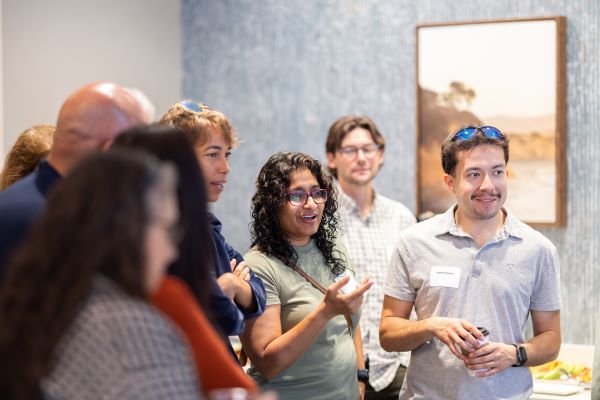
Held on Earth Day at the Hilton Garden Inn in Goleta, the forum connected a broader idea to a practical one: giving commuters more ways to get to work—without relying on a single option.
The forum, co-hosted by the Santa Barbara County Association of Governments (SBCAG) and the Santa Barbara South Coast Chamber of Commerce, and supported by Hilton Garden Inn and Southern California Edison, focused on turning a new transportation service into something employers can actually use—and employees can rely on.
“This is no longer a concept—it’s a service that’s launching and ready to use,” said Goleta Mayor Paula Perotte. “For a city like Goleta, where thousands of people commute in every day, having a peak-hour rail option gives employers a real option to reduce commute stress and expand access to jobs.”
Beginning May 4, the Amtrak Pacific Surfliner will add a new daily roundtrip and expand peak-hour service, increasing flexibility for commuters traveling between Ventura County, Santa Barbara, Goleta, and beyond. The service is designed to better match real-world work schedules, offering an alternative to Highway 101 congestion while improving regional connectivity.
Inside the forum, the conversation quickly moved beyond presentations. Participants rotated through interactive “World Café” discussions, surfacing ideas on everything from employer commuter benefits to first- and last-mile connections. A regional panel—including transit providers and mobility partners—responded in real time, highlighting tools already available and gaps still to solve.
“Today was an exciting step forward in providing an important asset to the business community on the South Coast – an improved connectivity and transportation option for the local workforce, said President & CEO of the Santa Barbara South Coast Chamber of Commerce, Kristen Miller. “What we saw is that the business representatives in the room are ready to be part of the solution, and ready to put what they learned to work for their teams.
Following the panel, attendees connected directly with transportation providers at commuter resource tables, where agencies including Santa Barbara Metropolitan Transportation District (Santa Barbara MTD), Ventura County Transportation Commission (VCTC), SBCAG, and BCycle shared tools and information to help employers and employees get started.
The forum emphasized a simple but critical takeaway: new infrastructure alone does not change behavior—people do. Employers play a central role in introducing and normalizing new commute options, whether through incentives, flexible policies, or simply encouraging employees to try the train.
“We’re not starting from scratch—this is about connecting the dots,” said Executive Director of SBCAG, Marjie KIRN. “With expanded rail service, local transit, bike share, and employer support, we have the foundation to make this a viable daily commute. The best way to see how it works is to get on the train and try it.”
Attendees left with postcards on how to redeem complimentary 10-ride passes and resources to help their teams experience the service firsthand—an intentional step toward building ridership early and evaluating the service’s long-term potential.
The expanded rail service is part of a broader regional strategy to provide more commute options alongside ongoing Highway 101 Carpinteria to Santa Barbara improvements.
Passenger rail between Ventura County and the South Coast is funded in part by the voter-approved Measure A transportation sales tax within Santa Barbara County, which invests in projects that reduce congestion and improve mobility.
For those who were unable to attend, information about schedules, fares, and how to get started is available at www.sbcag.org/train. SBCAG can also work with employers and individuals to help identify commute options that fit their needs.
As one theme echoed throughout the morning: the best way to understand the train—is to ride it.